In November 2020, National Cabinet endorsed the Australian COVID-19 Vaccination Policy, which committed to active and comprehensive vaccine safety monitoring and identified the TGA's COVID-19 Vaccine Pharmacovigilance Plan as part of that framework. In February 2021, the TGA published its COVID-19 Vaccine Safety Monitoring Plan, setting out the enhanced monitoring framework for the rollout.
The National Cabinet-endorsed Vaccination Policy describes the TGA's pharmacovigilance plan as improving state and territory adverse event reporting to the TGA, expanding active surveillance systems and enhancing signal detection and investigation. The Commonwealth–state agreements set out related surveillance and reporting commitments and are a key element of the Plan's implementation. The Victorian plan, for example, makes Victoria responsible for near-total population coverage of active safety surveillance and for timely reporting to the TGA of required safety surveillance data. The Australian Government Policy folder contains the underlying policy, Cabinet governance documents and Commonwealth–state implementation agreements.
The audit assesses 19 outputs, comprising the Plan's 17 numbered strategy items and two additional governance outputs, each evaluated for documentary evidence of implementation. The methodology is open, falsifiable and replicable. Every finding is traceable to a public or FOI-released source, and the full evidence base is published for independent scrutiny.
It examines 68.4 million doses (91.2% of Australia’s rollout) across four years and asks one narrow, verifiable question: can implementation of the monitoring plan, and the regulator’s compliance with its commitments, be independently confirmed from the documentary record, given enhanced monitoring’s intended role alongside provisional approval?
The audit did not identify documentary evidence that the TGA systematically implemented the enhanced vaccine safety monitoring framework described in its February 2021 plan, leaving compliance unverifiable from available records. Of 19 audited outputs, only 3 are fully documented; the remaining 16 are partially documented or undocumented from the available material.
Why does this matter?
When COVID-19 vaccines were provisionally approved for Australia's largest mass vaccination rollout, the National Cabinet-endorsed vaccination policy committed that the TGA would “actively and comprehensively monitor” them for safety. The TGA's COVID-19 Vaccine Safety Monitoring Plan (described in the policy as its pharmacovigilance plan), issued in February 2021, set out 17 numbered strategies. 68.4 million doses followed.
The TGA reported pharmacovigilance activity throughout the rollout, including more than 150 published safety reports, 150 safety signals investigated and 57 regulatory actions. That activity demonstrates that safety monitoring occurred. The audit examines whether the enhanced monitoring framework described in the Plan was implemented and whether its delivery can be independently verified from the documentary record.
The audit is grounded in the fundamental principles of public accountability and transparency: when public institutions make significant commitments, their implementation should be capable of independent verification through an adequate documentary record. A commitment to enhanced monitoring should leave a record showing what was delivered, who was responsible for tracking it and how performance was assessed.
The audit did not identify a Plan-level record demonstrating this, leaving delivery of the National Cabinet commitment, and accountability for it, unable to be independently established.
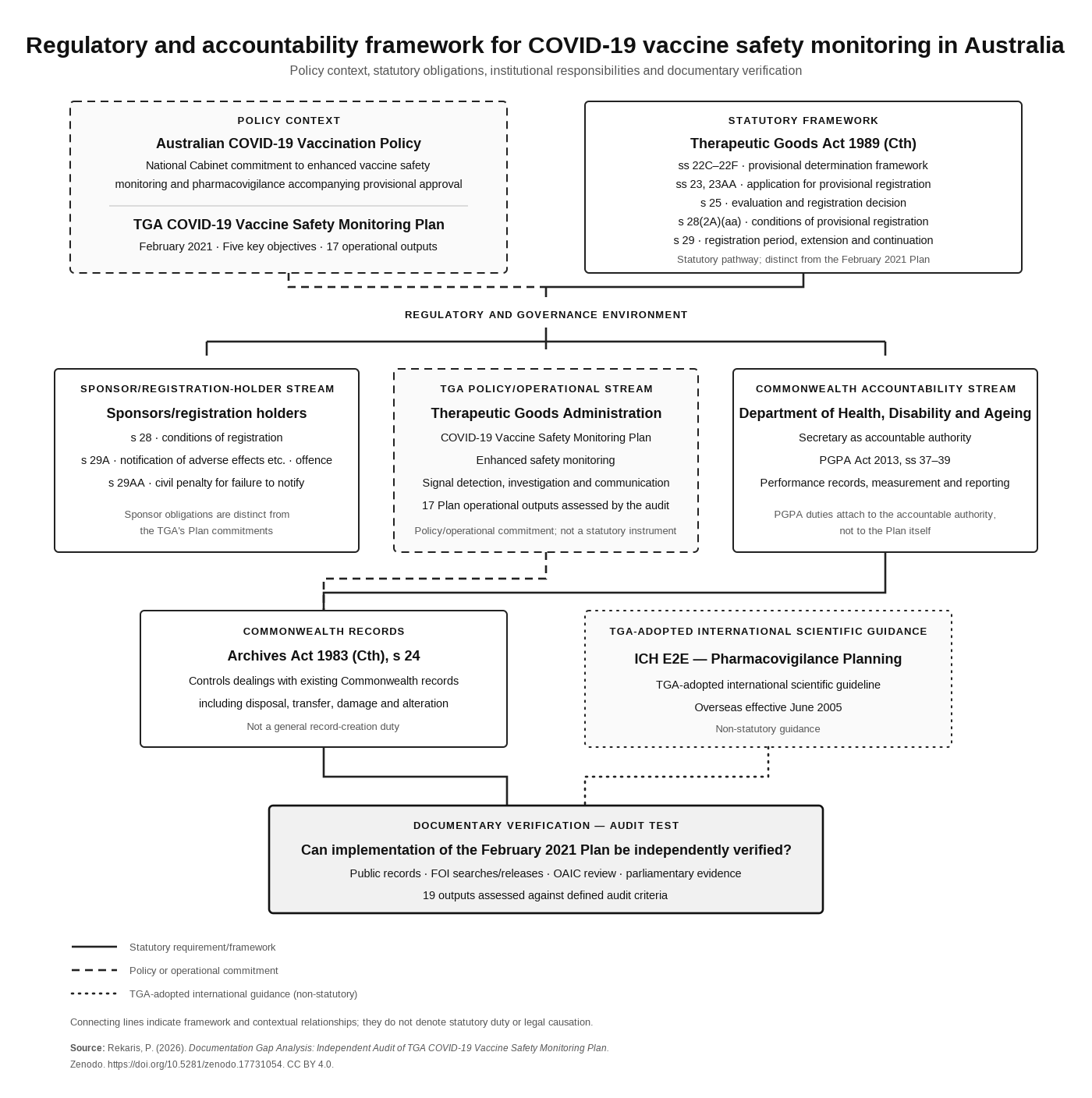
Regulatory and accountability framework
The diagram shows how the monitoring commitment in the Australian COVID-19 Vaccination Policy was operationalised through the TGA’s Safety Monitoring Plan. It separates sponsor obligations, the TGA’s operational commitments, Commonwealth accountability requirements and non-statutory international guidance, and maps them against the statutory framework for provisional registration. View the diagram
What the audit found
- 01 In September 2024, directed by the Office of the Australian Information Commissioner, the TGA's sample searches identified no Plan implementation records. The Commissioner found the report requested under FOI 3643 cannot be found or does not exist (Decision [2025] AICmr 54).
- 02 The TGA told the Senate (9 October 2025) that the Plan's five key themes “essentially describe our day-to-day processes”, its “standard sort of process in terms of post market surveillance and pharmacovigilance”, and that there is “no single specific evaluation report outlining or benchmarking us against the elements of that plan”. That describes routine processes, indicating that the Plan was not systematically tracked against its objectives, and the audit found no records showing otherwise.
- 03 In its written response to Senate Question on Notice 559, the TGA reports 150 safety signals investigated and 57 regulatory actions undertaken. The response does not link individual safety signal assessments to regulatory actions or decisions, and provides no signal-management documentation showing how evaluation outcomes connect to the reported activities or how the Plan's 17 numbered strategy items were monitored.
Questions and answers
Each answer applies the audit's evidentiary standard: what can be confirmed on the documentary record.
Did the TGA implement its COVID-19 vaccine safety monitoring plan?
The audit found that 16 of 19 outputs are partially documented or undocumented, and the TGA's OAIC-directed sample searches identified no Plan implementation records.
Didn't Australia already monitor vaccine safety?
Yes. The audit does not dispute that vaccine safety monitoring occurred. The TGA told the Senate it was part of its “day-to-day processes”. The audit examines whether the enhanced monitoring promised under the National Cabinet-endorsed Australian COVID-19 Vaccination Policy, and subsequently set out in the TGA's February 2021 Plan, was implemented as committed and can be independently verified from the documentary record.
AusVaxSafety, for example, conducted 6.8 million post-vaccination surveys. Strategy 2.4 of the Plan committed to “Establish real-time collaboration with COVID-19 active surveillance activities for safety signal detection and analysis.” AusVaxSafety existed and collected survey data. However, the available documentary record does not establish whether the collaboration promised in the Plan was implemented, or how active-surveillance data were integrated into the TGA's signal detection and analysis.
The Plan gave operational form to a national commitment to enhanced safety monitoring for a mass vaccination rollout. Whether implementation was centralised or distributed, the record should be capable of establishing what was implemented and how performance was assessed, consistent with Commonwealth recordkeeping and performance requirements. Verifying the Plan as an integrated framework also requires evidence of how its elements worked together and how decisions were made.
Who conducted this research?
The audit was conducted by Paul Rekaris, an independent policy researcher. It applies the international auditing standard ISO 19011:2018 to public and freedom-of-information records. The research has been cited in the Australian Senate and provided for consideration to the Senate Community Affairs Legislation Committee and the Australian National Audit Office. It is an independent citizen audit and invites a formal audit of its findings.
Can the findings be checked?
Yes. Every finding is traceable to a public or FOI-released source, and the full evidence base, methodology and dataset are openly published under a CC BY 4.0 licence for independent verification.
Can the audit be proven wrong?
Yes. The audit adopts a falsifiability principle: every finding can be tested against evidence and revised if the evidence requires. Any output classified as not documented can be overturned by the production of a single relevant record. The findings hold only while the documentary record remains absent, and any correcting evidence would be incorporated with transparent version history.
Further questions on scope, methodology, limitations and how to verify or challenge the findings are answered in the full FAQ.
Permanent record
Cited and corroborated
Office of the Australian Information Commissioner, Decision [2025] AICmr 54 (26 March 2025).
TGA evidence to the Senate Community Affairs Legislation Committee, Hansard (9 October 2025) · watch the TGA at Senate Estimates.
TGA written answer to Senate Question on Notice 559 (DHDA SQ25-001584, answered 21 January 2026).
Audit cited in the Australian Senate, Hansard (24 March 2026) · watch the Senate speech.